Today’s football is heavily influenced by technological advances and data analysis. If you analyze the tỷ lệ kèo ngoại hạng anh, you know one refereeing call can change a match completely. At the heart of this revolution is VAR (Video Assistant Referee). This guide explains what VAR is, how it works under current rules, and its impact on the game.
The core concept – What exactly is VAR?
VAR là gì? To put it in the simplest terms, VAR stands for Video Assistant Referee. It is not a single person, nor is it a computer making automated decisions; rather, it is a system designed to assist the on-field referee in correcting "clear and obvious errors" or "serious missed incidents" during a professional match.
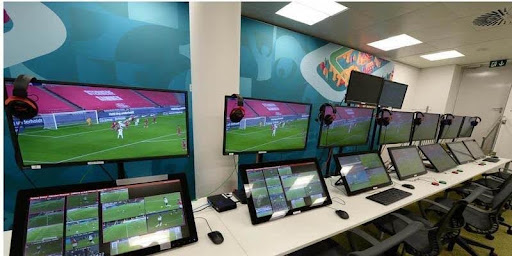
The VAR team includes a qualified referee or former referee, assistant VARs and replay operators. They work in a dedicated video room where they can review multiple camera angles at the same time. The system follows a simple principle set by IFAB: minimum interference and maximum benefit.
It is crucial to understand that VAR does not make the final decision. The ultimate authority always remains with the on-field referee. VAR acts purely as a safety net, an extra pair of eyes to ensure that catastrophic refereeing mistakes do not dictate the outcome of high-stakes football matches.
The four situations – When can VAR intervene?
To prevent football from losing its fluid, continuous nature, the governing bodies have strictly limited VAR intervention to only four game-changing scenarios. VAR cannot review a standard throw-in, a regular corner kick, or a minor yellow card. It can only check the following structural categories:
Goal or no goal
The VAR team automatically checks all moments leading to a goal. They look for infringements to invalidate it, such as the ball going out of bounds, an offside position in the buildup, or an attacking foul during the immediate phase.
Penalty or no penalty
Penalty decisions are season-defining. VAR reviews footage to ensure awarding or denying a penalty is correct. Operators verify if contact occurred inside the box, if a foul happened versus simulation, and if a handball occurred under the latest IFAB rules.
Straight red cards
VAR monitors violent conduct and dangerous play to maintain safety. Crucially, VAR only reviews potential straight red cards, never second yellow cards. The review targets serious foul play with excessive force, violent acts like punching or kicking, and the denial of an obvious goal-scoring opportunity (DOGSO).
Mistaken identity
On rare occasions, a referee might issue a yellow or red card to the wrong player due to chaos on the pitch or similar physical appearances. VAR will immediately alert the referee to correct the identity of the penalized player, ensuring fair play and accurate discipline.
How the VAR review process works step-by-step
The execution of a VAR review is a highly structured, multi-layered process designed to minimize delays while maximizing accuracy. The process progresses through three clearly separated stages:
Step 1: The check and communication
While the match is ongoing, the VAR team in the control room automatically checks every incident falling into the four allowed categories. If a potential error is spotted, the VAR will communicate with the on-field referee via a headset, saying, "Delay, delay, we are checking a potential offside/foul."
Step 2: The recommendation
If the VAR review reveals a clear and obvious error, they will recommend that the on-field referee change the decision or view the footage. For factual decisions, such as whether a foul was inside or outside the box, or if a player was physically offside, the referee can accept the VAR's data directly without looking at the screen.
Step 3: The on-field review
For subjective decisions, such as the intensity of a tackle or whether a handball was intentional, the VAR will advise the referee to conduct an On-Field Review (OFR). The referee will walk over to the Referee Review Area (RRA), the monitor located on the sideline to watch slow-motion and full-speed replays before making a final judgment.
How VAR enhances accuracy and fairness in football
The implementation of VAR has brought several undeniably positive changes to the sport, elevating the standards of professional football tournaments:
- Drastic reduction in blatant mistakes: Offside goals that would have stood in the past are now accurately ruled out, and hidden red-card offenses are consistently punished.
- Increased fairness and integrity: Teams are less likely to lose championship titles or suffer relegation due to a single human oversight by an assistant referee.
- Protection for players: Knowing that dozens of cameras are watching every angle discourages players from engaging in off-the-ball violence or malicious tackles.
- Data-driven transparency: Modern broadcasts display VAR lines and review reasons on stadium screens, providing real-time information to fans and analysts alike.
Critical controversies and the future of VAR
Despite its structural benefits, VAR remains one of the most heavily debated topics in sports bars and television studios across the globe.
The loss of spontaneity and stadium emotion
The primary criticism of VAR is that it disrupts the natural emotional flow of football. Fans and players can no longer celebrate a spectacular goal immediately; instead, they must look anxiously at the referee, waiting minutes for a silent check to conclude. The raw, ecstatic joy of scoring is often replaced by clinical administrative verification.
Subjectivity and the "clear and obvious" debate
The relationship between technology and subjective decision-making highlights a core limitation of the VAR system:
- Technology versus intent: While video replays show physical contact, they cannot interpret human intent or the intensity of a challenge.
- Differing interpretations: A tackle that appears to be a clear foul to one official can look like a standard physical challenge to another.
- Subjective guidelines: The definition of what constitutes a "clear and obvious error" remains highly subjective among referees.
- Shifting the blame: Instead of eliminating controversial debates, VAR has simply shifted the public criticism from the on-field referee to the video room.
Semi-automated improvements
To fix these flaws, football governing bodies have introduced Semi-Automated Offside Technology (SAOT). By utilizing specialized tracking cameras and artificial intelligence chips inside the match ball, the system can determine offside positions within seconds, drastically cutting down review times and restoring a smoother rhythm to the game.
Conclusion
VAR has permanently transformed professional football from a game of pure human error into a highly sophisticated, tech-assisted sport. While it still faces growing pains regarding subjective rules and emotional delays, its ability to ensure fairness and eliminate catastrophic mistakes makes it an essential tool for the future of the game.