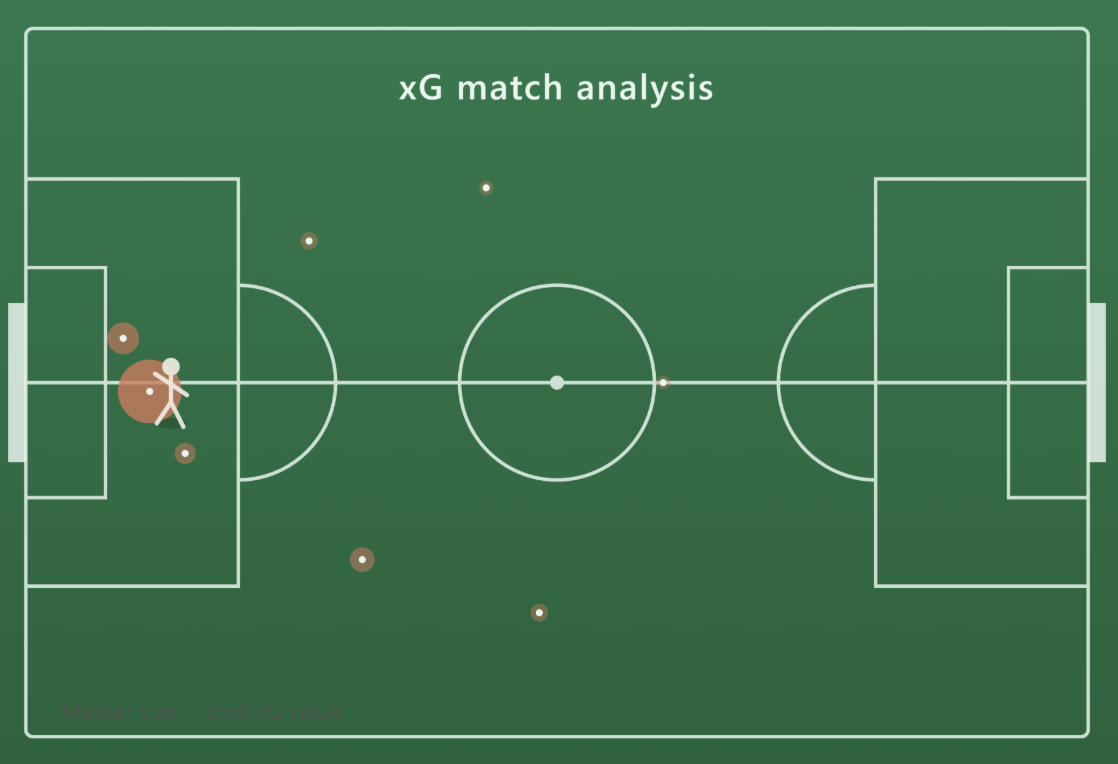
The analysis of football has changed a lot due to data and statistical modelling becoming widespread. Rather than solely using league standings, results from recent matches or personal opinion, analysts have access to more in-depth statistics including Expected Goals (xG), shots, possession, expected assists, defensive stats and other recent trends by the team.
One of the most important statistics in the analysis of modern football is Expected Goals or xG. xG is a model of the likelihood of scoring a goal based on a particular situation. Modern xG models take into account many aspects including shot location, angle, type of assist and other contextual information.
There has never been a sport in which controversy has played a greater role. Who has been the best at it? Who won it and how fair was their victory? For decades this debate continued using goals, attempts, and intuition. However, within the past decade, there has been an explosion of statistical measures that give an entirely new level of insight into what is going on in the game.
In this post, we will explain what xG measure is, what other statistical measures accompany xG, and how professional analysts use those measures together.
What Is xG?
Expected Goals uses probabilities for all goal-scoring attempts. For instance, an opportunity near the goal line with an easy way to score is assigned a higher xG value compared to one where the player shoots from a great distance.
The individual values can be summed up to provide a total estimation of how many goals a team would score given the nature of its goal-scoring opportunities.
This is very significant since the result of the match does not necessarily give the whole picture at all times. There could be a situation where a team loses the game but still had high-quality goal-scoring opportunities, and there are times when a team wins but has scored relatively few goals.
According to Stats Perform, some factors that can be considered in xG models include shot distance, shot angle, the type of the assist and header shots.
Why xG Matters in Football Analysis
Considering only goals can sometimes result in an incomplete analysis of performance. The team that won 1-0 could have had possession and been creating many scoring opportunities throughout the game or have spent the whole game defending to finally score from one chance.
It is for this reason that comparing goals with xG can be useful in determining whether a game result was justified by the chances that were created.
For instance, when a team creates a lot of xG opportunities but scores significantly less number of goals, then analysts will try to determine the cause of poor finishing skills, goalkeeping and chance creation. Conversely, when a team scores way above the xG, then the analysts could be tempted to conclude that the team has excellent finishing skills.
Important Statistical Methods for Football Analysis
A good football prediction model cannot rely on a single statistic. Multiple factors can be considered to create a larger picture of teams' performances.
- Expected Goals
xG takes into account the quality of goal-scoring chances. The comparison of the xG a team creates versus xG it allows can give a hint of the efficiency of its attack and defense.
- Expected Goals on Target
Expected Goals on Target (xGOT) takes into consideration the execution of the shot and its exact position within the goal area in addition to its initial quality. It can give some insight on shooting quality and goalkeeper's performance.
- Expected Assists
Expected Assists (xA) evaluates the probability that a completed pass turns out to be a goal assist. It can be helpful for assessing the quality of chances provided by certain players and teams.
- Shot Volume and Shot Quality
The volume of shots is important, but it has to be compared to the quality of the shots. There is no certainty that a team which creates 20 poor attempts would be more dangerous than another one which creates 10 quality chances.
The combination of total shots, shots on target and xG gives a better idea about attack efficiency.
- Recent Performance
The recent games of a team can show changes in its performance but one should avoid relying too much on any short win/lose streak as evidence of further results.
It is better to look at the recent performances in conjunction with long-term stats and the strength of opponents.
- Home/Away Performance
There are teams whose performances differ according to the location. Analysts can compare home and away scoring, defensive stats, xG, xGA, and shot creation to identify the difference.
- Defensive Statistics
Good football analysis has to include the performance of a team without the ball. Defense actions, goals against, allowed shots and xGA can give some idea about efficiency of defending and preventing the opponent from chances.
Moreover, advanced football datasets include detailed data about the positions of players, pressures and movements. For example, Stats Perform offers Opta Vision which includes tracking data.
How a Statistical Match Forecast Can Be Built
A logical approach for making a statistical prediction would involve first gathering data related to both teams. For example, analysts may use recent xG/xGA stats, attacks created, defense stats, home/away form, and player availability.
The second step is to consider the teams based on a number of parameters, rather than a single statistic.
For example, an analyst could ask:
- Which team creates higher quality scoring opportunities?
- Which team gives up higher quality scoring opportunities?
- How often does each team create scoring opportunities that are on target?
- Are recent results backed up by actual form?
- How much does it matter which players are missing?
- Is there an obvious home field advantage?
Have the teams been getting better or worse recently?
The Importance of Combining Statistics
There is no single metric that alone can describe a game of football. xG is important but must be considered in conjunction with other information.
For instance, there might be one team with excellent xG numbers playing against a team with an exceptional goalkeeper. There might be a team with good attack statistics but lacking some of its best creative players.
That is why professional football analysis today makes use of event and tracking data in addition to regular statistics.
Evaluating Prediction Quality
When analyzing any football prediction source, whether 100predict website or other sources, one has to consider verifiable past performance and not guarantee of accuracy.
Any good statistical analysis would have to track predictions before the match starts and compare it with actual outcomes using a large enough sample size. Some of the things that matter would be accuracy, calibration, sample size and performance on various leagues. It is far better method than picking some successful predictions after the match has ended.
Conclusion
xG and modern football stats allow us to analyze matches differently. Through the combination of Expected Goals, Expected Goals on Target, Expected Assists, shot quality, defensive stats, performance and context, it becomes possible to understand football using far more evidence.
The idea behind it is very clear, use stats in order to evaluate performance not just through the result or pure intuition. In this regard, xG turns out to be very helpful, as it allows to understand how high the quality of opportunities scored or conceded is, and other stats help to get some more context.
Football is always unpredictable, but statistical analysis can become more rigorous and objective through it.