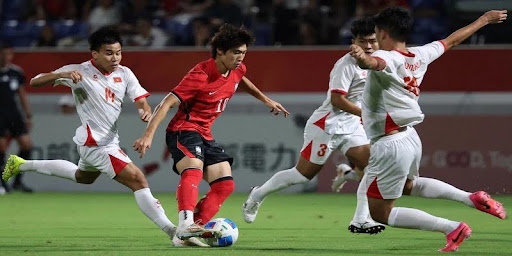
U23 Vietnam concluded its ASIAD 20 campaign in Japan among the final eight teams after three group-stage matches and a quarterfinal against U23 South Korea. Fans following the team's journey through thapcamtv experienced mixed emotions, from frustration against Kuwait and excitement after the win over the Philippines to tougher tests against Uzbekistan and South Korea. Overall, the tournament showed a competitive team capable of creating chances, although finishing efficiency and the ability to cope with sustained pressure remain areas that require further improvement.
U23 Vietnam journey from the group stage to the quarterfinals
The three Group C matches exposed U23 Vietnam to opponents with different playing styles, revealing both the team's strengths and several technical gaps that still need attention.
A draw with Kuwait in the opening match
The first match ended in a 1-1 draw against Kuwait, although the scoreline did not fully reflect the number of opportunities created by the Vietnamese side. According to VietnamPlus, coach Dinh Hong Vinh's team produced 27 shots, with six attempts on target, but only Ngoc My's equalizer in the 82nd minute found the net. Before that goal, Vietnam had also hit the post or crossbar four times.
For U23 Vietnam, the match clearly highlighted the problem of converting chances into goals. The team was able to move the ball into dangerous areas, sustain pressure, and generate a significant volume of attacks, but the quality of the final touch did not match the overall performance they had built.
An important victory over the Philippines
In the second group match, Vietnam secured a 2-0 victory over the Philippines, taking its total to four points from two games. The team controlled much of the first half, attacked through both flanks, and maintained pressure after the break until it eventually broke the deadlock.
The victory showed that U23 Vietnam responded positively after failing to obtain the desired result in the opening game. More importantly, the players improved their ability to capitalize on attacking situations, turning territorial superiority into a tangible advantage on the scoreboard instead of continuing to waste too many opportunities.
Uzbekistan presented a different challenge
The final group match brought Vietnam up against Uzbekistan, a team that had defeated the Philippines 5-1 in its opening fixture. Vietnam conceded in the fifth minute and allowed another goal in the 68th, finishing the group stage in second place with four points and qualifying for the quarterfinals.
The 0-2 defeat presented a different type of challenge for U23 Vietnam, especially against an opponent capable of applying pressure and punishing mistakes more effectively. While the first two games mainly highlighted finishing issues, the Uzbekistan match raised questions about defensive structure and the team's ability to respond when placed under pressure from the opening minutes.
Strengths and limitations across four ASIAD 20 matches
Beyond the results, the performances of U23 Vietnam revealed encouraging signs alongside several issues that must be addressed if the team wants to compete more effectively against stronger Asian opponents.
Competitive spirit remained consistent
One positive aspect was the team's refusal to give up easily when facing difficult circumstances. Against Kuwait, Vietnam equalized in the 82nd minute only three minutes after conceding. After the match, coach Dinh Hong Vinh also praised the players' attitude, fighting spirit, and overall cohesion.
When reviewing the action through thapcamtv link, supporters can focus on how U23 Vietnam maintained its intensity in challenges and reorganized after losing an advantage. This is particularly important for a young team because the ability to respond after conceding can directly shape how players develop in high-pressure matches.
Finishing still needs improvement
The statistic of 27 shots but only one goal against Kuwait was the clearest example of the team's lack of efficiency. Coach Dinh Hong Vinh also identified chance conversion as an area that needed improvement and said the coaching staff would review match footage, refine combination play, and improve decision-making around the penalty area.
For U23 Vietnam, improving finishing is not simply about asking strikers to shoot more accurately. The final pass, receiving position, timing of runs, and decision-making around the box all need to improve so that the number of chances created can be translated into more goals.
The gap became clearer against stronger opponents
In the quarterfinal on September 25, Vietnam's campaign ended with a 0-4 defeat to U23 South Korea. The post-match report from the Vietnam News Agency noted that the players continued to work hard, particularly in the first half, but South Korea pushed its defensive line higher and repeatedly applied pressure through attacks down both flanks.
The match provided a useful benchmark for U23 Vietnam when facing a team with greater speed and intensity. The large scoreline should not erase everything the team had achieved earlier, but it clearly showed the need to improve decision-making speed, defensive transitions, and the quality of physical contests.
What did ASIAD 20 offer the current generation?
The value of the tournament for U23 Vietnam was not limited to reaching the quarterfinals. The competition also gave the players experience against several contrasting styles within a short period.
The young squad was tested in competitive matches
Coach Dinh Hong Vinh selected a 23-player squad combining footballers with international experience and younger prospects. Before the tournament, the squad also changed when Nguyen Bao Ngoc and Hoang Quang Dung replaced Pham Dinh Hai and Nguyen Cong Phuong.
This process gave the coaching staff more practical evidence for evaluating players in official competition. For U23 Vietnam, performances against Kuwait, the Philippines, Uzbekistan, and South Korea offered far more useful information than assessments based only on training sessions or low-pressure friendly matches.
Experience must continue at club level
A short tournament can provide momentum, but it cannot determine the entire development pathway of a young player. After ASIAD, minutes played at club level, competition for starting places, and the ability to maintain physical condition will determine whether the experience gained in Japan develops into long-term progress.
For that reason, the journey of U23 Vietnam should be viewed as an important test rather than a final destination. The players were exposed to the demands of Asian football in terms of processing speed, finishing efficiency, and resilience under pressure, giving them specific areas to continue developing.
The quarterfinal was a milestone, not the only measurement
Advancing from the group stage was a notable achievement at ASIAD 20, but player development should not be judged only by the round reached. Vietnam scored three goals across four matches and faced increasingly visible limitations as the level of opposition improved, particularly against Uzbekistan and South Korea.
From this perspective, U23 Vietnam finished the tournament with both a foundation to build on and a clear list of technical priorities. The ability to create pressure and maintain fighting spirit can be developed further, while finishing, defending against stronger opponents, and faster decision-making still require sustained work.
Conclusion
U23 Vietnam finished ASIAD 20 with one draw, one win, and two defeats, reaching the quarterfinals before being eliminated by South Korea after four matches of steadily increasing difficulty. The team's positive signs included competitive spirit, the ability to create chances at certain moments, and a strong response after the opening match, while finishing efficiency and resistance to intense pressure still need improvement. If the lessons from Nagoya are followed by regular playing time at club level, ASIAD 20 can become a valuable stage in the development of Vietnam's next football generation.