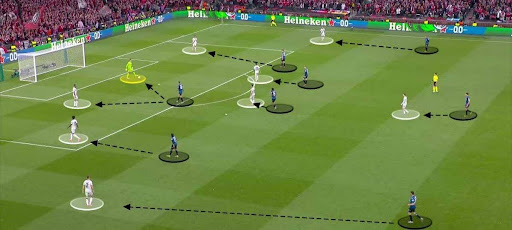
Prediction Logic in Football
Previously, most football forecasts were based upon gut instinct. You looked at the table. You checked out current forms. You thought about which team had better players and picked your teams. Sometimes, you would get it right; other times, you would not. For most of the fans, their predictions were based more upon intuition than on evidence-based testing and prediction.
However, while the evidence-based approach is becoming popular, many football fans continue to develop an understanding of how the game works, and the signs of a team being in danger when travelling away from home, how to read momentum shifts during a match, and when a team is not playing well, even if they have been getting good results.
Football has always been difficult to predict.
Indeed, any time a team is playing against another team, the way in which things have happened in the past can be used to indicate how likely it will be that people will have success in their predictions actually will come to fruition.
The Problem With "Feeling" A Match
Experiencing the frustration of a potential win, it’s easy for fans to see how a team that dominated previous matches loses or struggles against a much worse opponent with no previous record against them. This scenario illustrates how instinct can affect expectations; while fans have certain patterns that develop based on what they see, people will remember specific instances of emotional highs and lows (i.e., a dramatic game-winning goal, a star athlete’s dominant performance) rather than the consistency of a team or player against others. Fans also are subject to influence through the media as well, with many narratives created about teams that win games (i.e., the “winning-streak” team) or those who lose games (“the worst team in the league”) often affecting how people view them before the next match. However, fans are not seeing instilled into their psyche by the media so that they can develop rational approaches for the results of the subsequent games. The point is…while instinct is an important part of what we use to predict results; it alone cannot assimilate, understand, and process the true amount of statistical data that is available, especially the large number of matches that happen in the professional leagues every week.
Football may look chaotic at first glance.
A missed penalty kick, a defenders mistake, or a lucky deflection could change the outcome of the entire game. Therefore watching just one match may leave you with a sense that football is just naturally unpredictable.
Over time, however, you will see patterns.
Teams consistently repeat certain behaviors:
Some teams press high every week
Some teams have difficulty against teams that play defensively
Some teams are much better at home than they are on the road
Some teams play very fast with quick transitions
Others dominate possession but create few goal-scoring opportunities
These tendencies will not go away after one match result.
They will continue to re-occur from week to week and season to season.
Repetition is where football begins to show its structure.
The change to analyzing structures instead of opinions
Predictions about football now aren’t made solely on surface-level observation.
A current analysis focuses on the structure of performance instead of merely considering “Is this team winning?” and instead potentially assessing how that team is performing over time would provide a greater insight into their performance.
For instance, if a team has just won its last three matches but in each match has demonstrated some level of weakness defensively, it might be possible for this team to be included amongst the league’s top teams; on the contrary, if another team had lost several matches while demonstrating a consistent ability to generate good chances and control possession of the ball, it may not rank amongst the league's best.
Where conventional forms of predicting football matches often fail is due to their heavy reliance on results rather than process.
Current means of analyzing football attempt to establish more long-term connections amongst how teams perform, thereby providing the analyst with a more complete assessment of how teams operate.
The Limits of Traditional Prediction Methods
Predicting football matches isn't difficult—it's understanding all of the information available that presents the biggest challenge. Some days there are hundreds of matches played in multiple leagues, teams constantly change their tactics and players, teams often have injuries and deal with other issues throughout the season. It's nearly impossible for one person to track every single detail about each of those matches for an entire football season. This is when traditional prediction methods may fail; not because the analysis done by human beings was incorrect, but rather that the ability for one person to analyze all of that information accurately is limited. Even the most experienced football fan can overlook patterns, forget the context, and react emotionally when they are watching a game.
Why AI is a Natural Fit for Football Predictions
Artificial intelligence (AI) can change football predictions not by changing the way things happen in football, but rather by using its ability to analyze patterns at such a scale that humans will never consistently be able to do so. AI has no emotional connection to football nor does it have the ability to feel any part of what a fan feels when they are watching a game (e.g. pressure, momentum from a crowd, etc.), but it can identify repeatable patterns. It will analyze vast quantities of data from matches, compare trends in performance, analyze the tactical behaviors of teams from around the world, and examine how a team has performed over many seasons. These capabilities make AI an exceptionally useful tool for forecasting events in today’s football world.
The goal of using AI is not to make perfect predictions about the future; it is to provide a clearer picture of the current reality.
Predictions Are Probably Not Certanity
Football predictions come from using a combination of many different variables. Each prediction uses probability as a basis for predicting the outcome. All of these different variables create uncertainty.
Examples of random events that can affect the outcome are:
Red cards
Injuries
Defensive errors
Individual brilliance
Weather conditions
Psychological pressure
Thus, uncertainty will always be part of football.
Modern football prediction models are based on probability rather than certainty. Therefore, instead of asking, "What will definitely happen?" we now ask, "Based on the current circumstances, what has happened in the past that has a likelihood of happening again?" This change provides a more accurate view of the nature of football.
Why Consistency is More Important Than Results
Fans of the sport can often react to a single match's outcome with extreme enthusiasm or fear. A 3-0 scoreline will typically create a fanbase ready for the Super Bowl, while a one-off bad loss can prompt fear and angst statewide. Unfortunately, they can be misled in believing that they have gained insight into how the team will behave based on those results alone.
A team can win easily and look awful doing so, or conversely, lose due to an easy schedule yet execute a perfect game plan and create plenty of quality scoring chances. Therefore, consistency is what truly matters for fan sentiment and for fan-based expectations over a lengthy time period.
The most reliable source of information about how a club will perform going forward is based on multiple instances of the same type of behaviour happening repeatedly over time. The most effective prediction models are based on patterns of data that occur repeatedly because they provide a more consistent predictor of what is likely to happen in the future than do single instances.
How NerdyTips Fits into Today's Soccer Landscape
In this way, NerdyTips is very valuable in today’s soccer world. NerdyTips uses data to identify patterns within teams, leagues and players and creates a logical framework for organizing the complexities of soccer into useful structured information.
By analysing all behaviours of teams over varying difficulties within both matches and competitions, NerdyTips generates insights into the true logic of teams’ efforts on the field, their tactical tendencies and their levels of consistency.
This indicates a much larger trend within the analysis of football as a result of increased access to data through artificial intelligence.
Supporters of football have begun utilizing different viewpoints to create their future outcomes.
Today's statistics are being used in much more detailed manners compared to years' past (i.e., Expected Goals, Defensive Transitions).
There are also changes in how fans discuss the statistics (Pressing Intensity, Tactical Formations), as well as how fans determine the success of their teams.
Although in the past fans mainly relied on instincts alone when attempting to predict the outcome of games, many fans are now using both instinct and more structured knowledge to create a more objective view of their team prior to every match.
This new level of balance between feelings and facts is creating a new football culture experience.
AI Helps Create More Enjoyable Football Experiences For All Fans
Some individuals are concerned that improved statistics, along with the use of AI, to predict games takes away the emotional aspect of football.
In fact, the opposite has proven to be true.
The more you learn about the rhyme and reason behind a game, the more respect you have for a sport that is hard to play.
Once you have learned the rhyme and reason you start to notice things like:
Tactical Changes
Recurring Weaknesses
Formulating Strategies
The difference between winning and losing by the smallest amount;
The one thing that remains true, is there is no way to predict the outcome of any game, just has all game - it will happen no matter how you look at it.
By using AI, the passion that is connected to football by fans and has been for hundreds of years, will never be removed because any individual will be able to see how their passion can be matched to a number of different types of statistics.
Modern Fan Culture Includes Football Predications
Predicting the future of football is an integral part of the football experience for many supporters today. Fans are also very emotional during a football match; however, they want to know more about the game before the event starts such as:
• How teams have performed throughout the year.
• What tactical formations teams have used through the year.
• What are some hidden aspects/weaknesses of teams.
• What trends have continued throughout the year.
Because of this growing need for structured football insight, there has been an increase in demand for football insight services.
Fans are looking for clearer starting points in terms of what the outcome of a football game will be, but are not looking for guaranteed outcomes.
Surprises Still Occur with Football Games
Even though we are now living in a “technology-driven age”, the “game of football” still has the ability to be unpredictable. That is, there are still upsets by underdogs.
There are still top teams, that have been highly favoured to do well in a particular season, who do not perform well.
Major tournaments and league races still have a huge surprise element associated with their outcome.
The difference now is that while there may be an element of surprise associated with the outcome of a football game, people now understand why some of the events or outcomes were going to happen because of established patterns of behaviour. While the person may still be surprised by the outcome of the game, it is rarely viewed PROBLEMATICALLY because it appears to connect with the overall picture.
Conclusion
The development of football forecasts has markedly progressed in the past several years with respect to simply how the game is now predicted versus what was previously done.
Football is still as difficult/(hard) to predict but now more of a structured, data driven & consistent analysis process to obtain a better working understanding of football/the sport.
By using both common instinctual and more detailed research and analysis from different areas/numbers of data, there is more of an opportunity for fans to look beyond just what they see on the surface & try to find the reasoning behind the play and why performing teams played as they did.
Through the usage of the technology of AI (artificial intelligence) today, it is possible for each of these items to be much easier identified, tracked for consistency and processed on as a scale far larger than an individual can possibly process.
Sites such as NerdyTips provide a clear indication of the way that the football analysis process has evolved to a more sophisticated way of analyzing all players, types of plays and connection to long-term trends.
Football will always remain an emotional, unpredictable and thrilling game; however, once a person starts to really see the logic and reasoning behind the chaos of gameplay, their ability to make predictions does not seem to be chance or random but instead more of an extension of some form of fundamental understanding of the game.