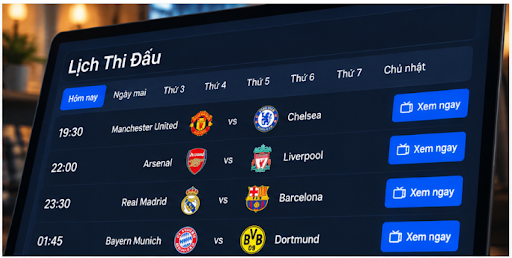
Football supporters today can follow dozens of competitions from different countries every week. Domestic leagues, cup tournaments, continental competitions, and international matches often overlap, making a reliable schedule an important tool for anyone who wants to organize their viewing. A football schedule does much more than show kickoff times. It can also provide useful context about competition stages, venues, fixture congestion, and the importance of a particular match.
For readers who regularly compare matches, learning how to interpret schedule information properly can make football coverage easier to understand. Instead of simply looking at the date and time, fans can use the fixture list to evaluate the wider context surrounding each game.
Start with keo nha cai to Organize Match Information
When exploring football information through keo nha cai, one useful starting point is the list of upcoming fixtures. A schedule allows readers to quickly identify which teams are playing, which competition the match belongs to, and when kickoff is expected.
This is especially important during weekends when several leagues may have matches at similar times. A clear fixture list helps prevent confusion between domestic league games and cup matches.
Readers should also check the listed timezone. Some websites automatically display local time, while others use the timezone of the competition or another reference point.
Check the Competition
Knowing the competition helps explain how teams may approach a match.
A regular league fixture normally follows a points-based system, while a knockout cup match may require extra time or penalties. Two-leg competitions create additional context because a team may enter the second match with an aggregate advantage.
Understanding the tournament format makes it easier to interpret tactical decisions and squad rotation.
Look at Home and Away Status
The order of the teams on a schedule usually indicates which club is playing at home.
Home advantage can matter because teams are familiar with the pitch, travel less, and often receive stronger crowd support. However, the importance of home advantage varies between teams and competitions.
Fans should therefore consider home and away form separately instead of relying only on the overall league record.
Use Lịch thi đấu to Check Fixture Congestion
A detailed Lịch thi đấu can reveal whether a club is entering a busy period.
A team competing in domestic and continental tournaments may play several matches within a short number of days. This can lead to rotation, fatigue, and tactical changes.
For example, a manager may rest important players in a league match if a major European fixture is approaching. Looking at the surrounding schedule helps readers understand why a starting lineup may differ from expectations.
Confirm the Kickoff Time
Kickoff times sometimes change because of television scheduling, weather, stadium issues, or competition decisions.
Fans should therefore confirm the latest listed time rather than relying on an old screenshot or social media post.
For international matches, timezone differences can create further confusion. Checking the date carefully is particularly important when a game takes place late at night in another country.
Consider Travel Requirements
Travel can affect preparation, especially in international competitions.
A team traveling across several time zones may have less recovery time than a local opponent. Domestic travel usually has a smaller effect, but long trips can still influence preparation when the fixture calendar is crowded.
Travel should not be treated as a guarantee of poor performance, but it is useful context when combined with rest days and squad news.
Watch for Postponements
Football matches can be postponed for many reasons, including bad weather, security concerns, stadium problems, or scheduling conflicts.
A fixture page should be updated when these changes occur. Supporters who follow several competitions should check the status of a match close to kickoff, particularly during periods of extreme weather.
Compare the Schedule with Team News
The fixture list becomes more useful when combined with confirmed squad information.
A club may have several injured players or suspensions that influence team selection. A busy calendar can make those absences even more significant because replacement options may also be limited.
Confirmed lineups usually become available shortly before kickoff and provide the clearest picture of the players expected to start.
Why Match Context Matters
A fixture does not exist in isolation. League position, recent form, tactical priorities, and competition goals can all influence how a team approaches a game.
For example, a club fighting relegation may play cautiously away from home, while another team pursuing a title may take more attacking risks. Similarly, a side with a major cup match three days later may manage its energy differently.
The schedule helps readers identify these circumstances before analyzing other statistics.
Avoid Reading Too Much into One Detail
It is easy to focus on one factor, such as the number of rest days, and assume it will decide the result.
Football is more complex. A strong squad may cope well with a crowded calendar, while a weaker team with a full week of rest can still struggle.
Fixture information is therefore most useful when combined with form, injuries, tactics, and recent performances.
Conclusion
A football schedule is much more than a list of dates and kickoff times. It provides important context about competitions, home and away status, travel, fixture congestion, and possible squad rotation.
Fans who use schedule information carefully can understand matches more clearly before kickoff. By checking the latest time, competition format, surrounding fixtures, and confirmed team news, readers can build a more complete picture of the game without relying on a single statistic or assumption.