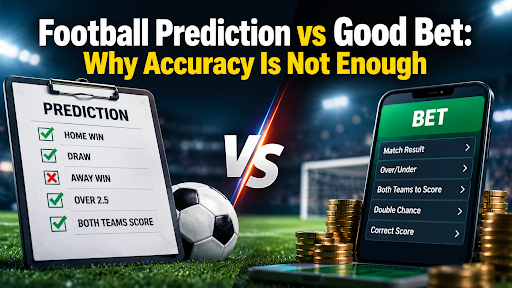
A football prediction can be correct and still be a bad bet.
That distinction is easy to miss because prediction sites naturally focus attention on outcomes. Home win. BTTS. Over 2.5. Correct score. The match ends, and the prediction is marked right or wrong.
But betting adds another variable that prediction accuracy alone cannot capture:
The price.
If you think a team has a 70% chance of winning, that is useful information. Whether you should bet on that team depends on the odds being offered.
A likely winner and a good bet are not the same thing.
The Most Likely Outcome Can Still Be Overpriced
Imagine Real Madrid is at home against a much weaker opponent.
Everything points toward a home win.
You estimate Real Madrid's probability of winning at 75%.
The sportsbook offers 1.20.
At 1.20, the implied break even probability is 83.3%.
So even though you believe Real Madrid is very likely to win, your own estimate says the sportsbook is asking you to pay too much.
You can be completely correct that Real Madrid is the most likely winner and still decide not to bet them.
Now suppose the price is 1.50.
That implies a break even probability of 66.7%.
If your estimate remains 75%, the decision looks completely different.
Same team.
Same match.
Same prediction.
Different price, different bet.
This is why saying "I think they win" is only half of a betting opinion.
Accuracy Can Actually Hide Bad Betting
High prediction accuracy sounds impressive because it feels like direct evidence of skill.
It can be.
But accuracy becomes much less informative when you do not know the odds behind the predictions.
Consider two predictors.
One wins 60% of selections while usually betting around 1.60.
At 1.60, a bettor needs to win 62.5% just to break even.
A 60% hit rate would lose money.
Another predictor wins only 45% of selections but consistently takes odds around 2.40.
The break even point at 2.40 is about 41.7%.
That lower accuracy could still produce a profitable record.
If you only compare 60% against 45%, you would choose the wrong record.
This is one reason prediction accuracy should never be evaluated separately from price.
A predictor can improve their headline accuracy simply by selecting more short priced favorites. That may make the results page look safer without creating better betting decisions.
Break Even Probability Is the Number That Connects Prediction and Price
You do not need complicated mathematics to make this distinction useful.
With decimal odds, break even probability is simply:
1 divided by the odds.
At 2.00, you need to win 50% of the time.
At 1.80, about 55.6%.
At 1.50, about 66.7%.
At 1.30, about 76.9%.
The practical question is whether your estimated probability is higher than the probability required by the price.
Suppose your BTTS analysis suggests both teams score around 60% of the time in this particular matchup.
At 1.80, the sportsbook price implies about 55.6%.
There may be value.
At 1.60, the implied probability is 62.5%.
Now your analysis can still say BTTS is the most likely scenario while the price says not to bet it.
The football prediction did not change.
The betting decision did.
An Apparently Safe Accumulator Can Be a Collection of Bad Prices
Short prices create another psychological trap.
A bettor looks through the day's fixtures and finds several selections that seem highly likely:
Home win at 1.30.
Over 1.5 goals at 1.25.
Double chance at 1.20.
Another favorite at 1.35.
Individually, each selection feels safe.
Combining them can make the final price feel attractive without changing the basic issue.
Every extra match introduces another condition that must be correct.
And if some of those short prices were already poor value individually, combining them does not fix the problem.
It packages several questionable prices together.
This is why accumulator analysis should start at the leg level.
If you would not take a selection at its current price on its own merits, adding it because it increases the accumulator payout makes little sense.
A Prediction Record Without Original Odds Is Incomplete
Suppose somebody shows you 700 historical football predictions and a strong win percentage.
That is more useful than seeing the last 10 winners.
But one major question remains:
What were the odds?
Without original prices, you still cannot properly judge the betting performance.
A 1X2 predictor taking favorites at 1.25 should naturally win more often than someone betting underdogs at 3.00.
Their win percentages should not be compared as though they were solving the same problem.
This is why current predictions become more informative when they can be viewed together with the historical performance of the person making them. Platforms such as TipMaster are one example of this approach, combining current tips with transparent tipster performance histories.
The useful record is not simply how often somebody was right.
It is what they predicted, at what price, and what happened over a large enough sample.
Winning Does Not Prove the Bet Was Good
This is probably the hardest idea to apply consistently.
You bet a team at 1.50.
They win 3 to 0.
Good result.
It tells you almost nothing about whether 1.50 was a good price.
Suppose the team's true chance of winning was only 55%.
The fair price for a 55% probability is around 1.82.
Taking 1.50 would have been a poor decision even though the bet won comfortably.
The reverse is also true.
Imagine you estimate an underdog has a 45% chance of winning and you can bet them at 2.40.
The market price only requires a 41.7% break even rate.
The bet loses 1 to 0.
That individual loss does not prove your original reasoning was bad.
Football contains variance. Penalties, red cards, deflections and finishing can decide individual matches.
Outcome quality and decision quality are different things.
A good decision can lose.
A bad decision can win.
You only begin to see the difference across repeated bets.
Confidence Is Not a Price
Football analysis often ends with language such as strong pick, high confidence or likely winner.
Those descriptions are incomplete until they are connected to odds.
Being highly confident that something happens does not tell you how much you should be willing to pay for that probability.
If you believe an outcome happens 80% of the time, you should think very differently about odds of 1.40 and 1.15.
At 1.40, the implied probability is 71.4%.
At 1.15, it is roughly 87%.
The same confident prediction can represent potential value at one price and poor value at another.
That is the shift that makes football predictions more useful.
Do not stop at:
What do I think happens?
Add one more question:
Is the available price better than the probability I assign to it?
That is where prediction becomes betting.