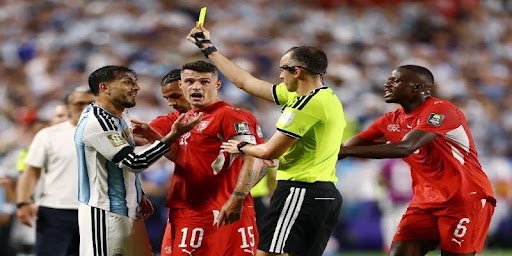
Card betting in football turns on a fact most people find counterintuitive the first time they check the numbers: the referee matters more than either team. Officials vary enormously in how readily they reach into their pocket, and that variation exceeds almost any difference between the sides on the pitch. Once you accept that hierarchy, a market that looks like guesswork becomes genuinely researchable. This guide covers the market structures available, the five rules that matter, and the errors that repeat most often on the board at 7mcn.
Card betting in football market structures
At 7mcn , Understanding how each variant settles prevents the frustration of watching a booking arrive and still losing on a technicality.
Total cards and the booking points system
The simplest form is an over or under on the number of cards shown. Many operators instead use booking points, valuing a yellow at ten and a red at twenty five. A second yellow typically counts as ten plus twenty five rather than ten plus ten plus twenty five. Knowing which system applies is the first step in card betting in football, since a line of forty five means something entirely different under each. Confirming the format before placing avoids settling disputes that were never necessary.
Team card handicaps and first card markets
Beyond totals, you can back one side to collect more cards than the other, or predict which team receives the opening booking. First card markets are more predictable than their prices suggest, because the team likely to chase possession early tends to commit the first tactical foul. Pressing sides and teams defending narrow leads in the opening stages produce bookings at a consistently higher rate than those dictate comfortable possession.
Settlement details worth confirming
Cards shown to substitutes and coaching staff count in some markets and not others. Cards issued after the final whistle almost never count, while those shown during a half-time incident usually do. These rules vary between operators, so reading the terms once saves repeated confusion later. A single overlooked clause can turn a winning position into a void bet or an unexpected loss, making pre-match verification a basic discipline rather than an optional step.
Five rules for card betting in football
These five cover most of what separates a considered position from a guess about which team looks aggressive.
- Start with the referee, not the teams. Officials range from under three cards per match to above five, and that gap outweighs any difference between the clubs involved. The appointment is usually published several days ahead, giving enough time to build a clear picture before lines move.
- Adjust upward for derbies and relegation clashes. Fixtures with genuine stakes or recent history between the clubs run hot, while dead rubbers late in a season run noticeably cold. Context multiplies whatever base rate the teams bring, sometimes dramatically.
- Look at foul counts alongside card counts. A side committing many fouls without accumulating bookings has simply met lenient officials. Pair that team with a strict referee and the total rises quickly, which is why this comparison sits at the centre of card betting in football.
- Account for competition-specific standards. Domestic leagues, cup ties and continental fixtures are officiated to different thresholds, so applying a league average to a European night produces misleading estimates that quietly erode an otherwise sound approach.
- Avoid lines set in the middle of the distribution. When the line sits exactly where most outcomes cluster, variance dominates and your research advantage shrinks accordingly. Edge comes from finding spots where the market has drifted from the referee's actual tendencies.
Where card betting in football goes wrong
Even bettors following the rules above lose money through a small number of recurring misjudgements.
Assuming physical teams always collect more cards
Physicality and disciplinary records are related but not identical. Some sides commit many tactical fouls in midfield while staying disciplined in the challenges that actually get punished. Checking cards per foul rather than cards per match reveals which category a team belongs to, and that distinction changes the estimate considerably.
Underestimating how video review reshapes frequency
Video review alters disciplinary patterns in both directions, catching incidents officials missed while overturning cards issued in error. Competitions with and without it produce noticeably different distributions, so historical data from one should never be transferred directly to the other.
Overstaking a genuinely high-variance market
A single flashpoint can produce four cards in thirty seconds and destroy a well-researched under position. That is the nature of card betting in football rather than a flaw in your analysis. Keeping stakes at three to five percent of a session budget acknowledges this honestly. The board at 7mcn lists totals and team card lines together, making it straightforward to compare before committing. Building slips entirely from card selections compounds the problem badly, since they share officiating conditions as a common driver and can fail simultaneously.
Conclusion
Card betting in football rewards a clear hierarchy of attention: the referee first, the fixture context second, and the teams third. Confirm which settlement system your operator uses before anything else, check the official's average across multiple seasons rather than a handful of recent matches, adjust upward for fixtures with genuine heat and downward for those without, and compare foul counts against card counts to identify teams whose records are misleading. Steer away from lines sitting in the middle of the likely range, keep stakes modest, and avoid slips built entirely from correlated selections. Applied patiently across a season on the board at 7mcn, Kết Quả Bóng Đá becomes one of the more genuinely researchable corners of football wagering.